You have no idea how good you look

People are the worst judges of how they look. I came to realize this while looking through some friend’s profiles in facebook. Typically the pictures they chose as “profile pictures” – ie. “the picture that best represents you right now” looked nothing like them. Most of the girls were giving silly coy poses and making the duck face. What is up with that? Seriously.

What were your favourite pictures in your high school yearbook? It certainly wasn’t the face listings, and it wasn’t any of the posed shots. It was always those “captured moment” shots from dances, sporting events, whatever. It’s the pictures that were taken when the subjects didn’t know anyone was watching. It’s the pictures of you in a moment where you’re just being yourself. Let’s face it, you’re awesome! The sad part is that even if you agree that you are awesome, you probably don’t think you’re that physically attractive. I’m looking at you: women. I don’t know a single woman who doesn’t think she’s ugly in some way. She’s either too fat, too thin (a rarity), too veiny, too wrinkly, hair is too curly, hair is too straight, too hairy, too balding. You get the point.

Why can’t people just be happy with themselves? If you get up in the morning, make sure you don’t stink (shower), make sure you don’t look absolutely ridiculous (wear untorn, well-fitted clothes, comb your hair, etc), I can guarantee that the only person who thinks there is something wrong with your physical appearance that day will be you. You’re too damn self-conscious. You need to accept that it is the person you are underneath your skin who people really see.

That is why my favourite feature of Facebook is the “Pictures of ” album. This is the album of photos taken of you by other people. Photos that people have tagged you in, that you didn’t even know were being taken. These are the closest you will probably ever get to capturing who you are in image format. The shittiest part of it is that many people I know end up requesting that a large majority of these pictures be untagged (it’s their right in facebook to request this) because “my arm looks fat”, or “you can see my mole”, or “my ear looks weird”. It’s stupid. Let the chips fall and show people who you really are. No-one is going to think you’re ugly, and those who know (or have known) you will appreciate the glimpse into the awesomeness of you.

I really don’t want to get in trouble with folks for putting up pics that they don’t like, so here are a few examples of the types of pictures I’m talking about from my “photos of mark” album in Facebook. These people are all awesome:

CE(Uh)O

No Doubts

Fred Wilson states that (a wise VC he knew stated):

A CEO does only three things. Sets the overall vision and strategy of the company and communicates it to all stakeholders. Recruits, hires, and retains the very best talent for the company. Makes sure there is always enough cash in the bank.

Fred goes on to say:

I’ve learned that great CEOs can and often will do a lot more than these three things. And that is OK. [...] But I have also learned that if you cannot do these three things well, you will not be a great CEO.

I wish Fred had posted that on the web a year before he did, and I wish I was wise enough to understand what it meant at that time.

When we took Vanilla through the TechStars program in Boulder in 2009, we really went there for the mentorship & networking. The program most definitely delivered on that account, and we came through a gruelling 3 months with our minds in heavy “listen to your mentors” mode. After leaving the program, we were able to raise a round of financing, and Vanilla’s Board of Directors was born.

We have an awesome board of directors at Vanilla with, we believe, some incredibly smart people who bring unequaled insight to the table. This fact, combined with the fact that we had just come out of a program where we had been heavily (and happily) mentored led to one powerful problem: I was not a good CEO.

The part of Fred’s quote above that got me was that a CEO “Sets the overall vision and strategy of the company and communicates it to all stakeholders.”. I failed at this job. Miserably. Instead of coming into board meetings with strong opinions about what we are doing and where we should take the company, I was deep on the other side of the fence: asking (practically begging) for advice, always willing to accept criticism on decisions to the point where I never sounded confident in any of them. I treated our board of directors like mentors instead of equals.

The hard lesson that I’ve learned over the last year is that when you put yourself in a diminutive position, people will treat you accordingly. In other words, if you act like you might be wrong, people will assume you are wrong. And if you act that way all the time, they will think that you just don’t have any idea what you are talking about.

It’s a hard fact to remember, but for all their experience, investors put their faith (and money) into your company (ie. you) because you are the experts in your field. You should always have the strongest opinions about the direction of your company from day-to-day tasks to overall vision & strategy.

I’ve spoken with many CEO’s about the struggles of being one, and there are many pitfalls that my friends and colleagues have experienced – this one being no exception. I hope that someone (perhaps the latest companies leaving the warm embrace of TechStars) reads this and takes it to heart.

Wonderful Wonderful

I finally have an excuse for never posting to my blog anymore, and she’s a wonderful one we’ve named Frankie.

Me & Frankie

Shenanigans at Grow Conference in Vancouver

Last week I attended the Grow conference in Vancouver, where I had an amazing time meeting smart and talented entrepreneurs from across Canada. There are some truly groundbreaking things happening up here in the great white North.

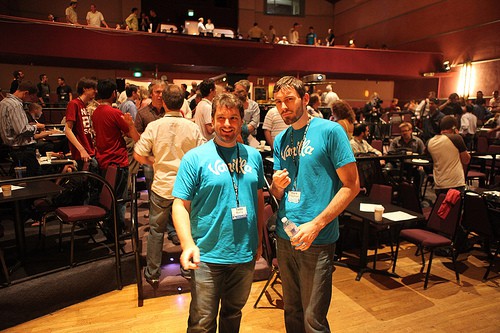
During the second day of the conference, a small group of us got together and rented a boat to do a tour of the Harbour. Those people are:

Scott Annan is the founder of Network Hippo in Ottawa, which is “a powerful and unique network relationship management tool that helps you build stronger relationships with people that matter. [They] help you stay in touch, reach out, and build stronger relationships.”.

Scott Lake and Craig Silverman founded SWIX aka “Social Web Index” (also in Ottawa) which is “a social media analytics application that monitors all of your social media properties (Facebook, Twitter, YouTube, +20 others). Each day, SWIX gathers visitor and usage data for your sites, graphs it over time and puts everything in one convenient place for you.”

Leila Boujnane founded Idée Inc. in Toronto, which is “develops advanced image identification and visual search software.” They do all kinds of cool stuff, and if you are a designer, you should check this out, and definitely check this out.

The five of us got up to no good while out there. My flickr pictures from the trip are here, and we also have this video entitled “Bye Bye Mark O’Sullivan”:

Bye Bye Mark O’Sullivan

Don’t Suck at Email

spam

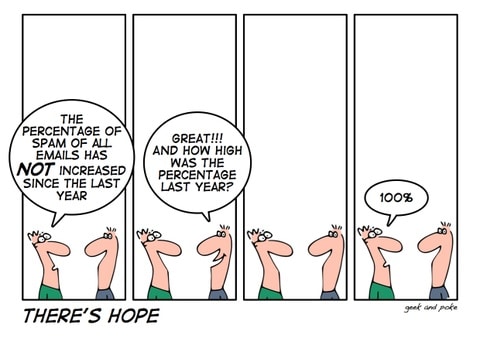
One of the bigger lessons I learned over my time in Boulder at TechStars was this: Don’t Suck at Email. Now that I consider myself to be quite good at email, it pains me to see people suck at it. And the sad truth is that most people truly suck at email. This was a topic we discussed a lot over the Summer, so I hope in sharing this information I can help a few people.

Seven Rules to Not Sucking at Email

1. Use the Subject Line – Sounds simple, but it amazes me how many people send out emails with useless subjects like “hey”, or worse – no subject at all. The subject line is not only the first glimpse a person gets of your reason for contacting them (which is extremely important if you are cold-emailing someone), but it also is a key piece of information that people might search on when trying to find your email some time down the road. Take a moment to actually think about the purpose of your email. Keep it between 2 and 7 words. Make it descriptive and succinct.

2. The “Three Sentence Rule” – This is one that can be tricky to use across all emails you send, but it is definitely worth using when you are reaching out to people who (a) you don’t know personally, (b) you have never contacted before, or (c) you know suck at replying to emails. Keep your email body down to three sentences. I know that you might feel the need to put more information into an email than three sentences, but the reality is that the people on the other end of the line are giant question-marks. You don’t know how busy they are, how much they suck at email, how interested they are in what you have to say, etc. If you go above three sentences, there is a high likelihood that they will not reply to your email. It can be challenging at first, but eventually you’ll find that you can get your point across in an extremely succinct manner. Only ask them one question, and put it in your last sentence. This leaves the question lingering in the other person’s mind, and it allows them to quickly shoot you back a response without feeling the pressure of a mass-volume, heavy-content email that will require more than 1 minute of their time. Most importantly, it gets the volley of conversation started, so your more detailed questions or information can follow-on in a conversation that the other person is now invested in.

3. Spell Check – If you are not great at spelling, use the spell checker. Nothing makes you look dumber than bad spelling and bad grammar. Simple, but true.

4. Reply to Important Emails Right Away – I used to get important emails and decide that I needed to think about the response for a long time before replying. I didn’t want to send knee-jerk emails back that had incomplete information. So, I’d wait a day, maybe two days, or sometimes as long as a week. Two things happen when you do this: First, the person on the other end thinks that (a) you didn’t get the email, (b) you don’t care about the email, or (c) you are a complete idiot. Second, you could possibly forget to ever reply at all. So, when I get important emails, I reply to them right away – even if I don’t have all of the information the person needs, I’ll tell them that I don’t have it, but I’ll get it to them by X date, and then I set a reminder and make sure that I get them that information by the time I said I would.

5. Use “Unread” Status – This is a habit I’ve picked up, and I find it extremely useful. If I read an email that isn’t very important, but does require a response from me, I’ll leave it marked as “unread” until I have the time or information required to respond. Every time I open my email program, I see X unread messages, and I am reminded of the emails I need to respond to. At least once a day I know I have the time to respond to those emails (typically first thing in the morning), so I’ll go back and make sure that everyone gets the information they need.

6. Be Conscious of How Much You Suck – If you send out emails that you consider important and you don’t get a response, think about why that might be. Go back up to the points above and compare the rules to the email you sent: Did you use a descriptive subject? Was the body of your email full of too much information, or did you stick to the three sentence rule? Did you only ask one question, or did you manage to squeeze more than one question into your three sentences? Did you have spelling mistakes? Was your grammar so bad that the email didn’t even make sense? If you’ve done a good job on all of those points, then we fall into point 4: the person you are trying to contact (a) didn’t get the email, (b) doesn’t care about the email, or (c) is a complete idiot. Because so many people suck at email, I’ve often found myself falling into the (b) category. No matter which way the cookie crumbles, you need to remember the most important rule of all when sending emails…

7. Be Persistent – No matter what the reason is for someone not replying to you, persistence will get you everywhere. The best way to be persistent and not be annoying is to use rules 1, 2, and 3. Keep your emails about the business at hand, and don’t let emotion get involved – which can be difficult if you’re dealing with someone who sucks at email. The last bit of advice I can give on this point is to remember that we all live in the real world. Email is fast and easy, but the reality is that not everyone uses it, and not everyone cares about it. I know it’s scary, but if you’re dealing with someone who sucks at email, sometimes you just have to pick up the phone and call them.

How to Handle a Pull Request from GitHub

pull-requests

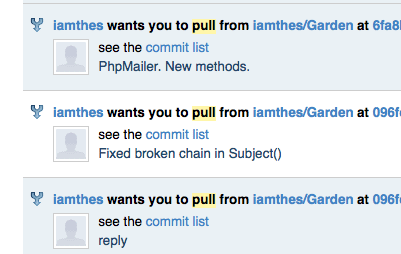
We decided to pick up Git for the Vanilla & Garden projects after discussions we had with people from many other companies while we were in TechStars this past summer. Git is still a bit of an enigma to me, and I’ve been receiving pull requests from people for a while, and I’ve failed to successfully get their changes into my code – instead opting to just manually apply their changes with my own IDE. That is, of course, a total waste of my time and contrary to the entire purpose of us adopting Git. So, today I finally sat down and dug my way through to figure out how to handle a pull request.

After a few hours of frustration, it finally makes sense. Here’s the long and short of it: Define the user’s remote repo, get a local copy of their work, go into the branch you want to pull their changes into, and cherry pick their commit into your branch.

Here are the actual commands I used to accomplish this for a number of different pull requests today:

Step 1. Do you already have their repo set up as a remote branch on your dev machine? Check with:

git remote -v

If not, add the remote branch and fetch the latest changes with:

git remote add -f <username> git://github.com/<username>/Garden.git

Note: “Garden” is the name of our project on github. Obviously, you would need to substitute that for your project name.

2. Do you already have a local copy of their repo? Check with:

git branch -a

If not, create it and check it out with:

git checkout -b <username>/master

If you do already have a local copy of their repo, fetch the latest changes:

git fetch <username>

3. Get their changes into your personal working branch:

git checkout master
git cherry-pick <hash of user's specific changes that they requested you to pull>

That’s it. I can’t believe it took me so long to figure that out!

The Green Room

TechStars in Seattle

I just got back last night from a TechStars event in Seattle. The event was an opportunity for TechStars teams from all locations and years to get together and share the challenges they’re facing in every aspect of their businesses. Beyond that it was a great opportunity to meet some of the people from the Seattle entrepreneurial community and some of the fantastic mentors out there.

Listening to the other teams speak, the thing that really struck me was the different stages the companies were at based on the year they “graduated” from TechStars. Teams from the first year ranged from completely disbanded to successful exits (some of whom are onto their next big ideas). Teams from year two fascinated me most of all, as they represented the place where Vanilla can be a year from now. Some were struggling, others were seeing great success through bootstrapping alone, and others were considering new rounds of financing. Finally, the teams from this year (my “class”) were all in roughly the same boat – at or near closing their first round of financing, starting to hire staff, and really cranking hard at improving their products and services.

What struck me about the spectrum were the levels of what I’m calling “green”. I believe that we’re never going to know everything, and everyone is always in an intense state of learning – especially in start-ups, where there is always more to do than you had anticipated. I found that the knowledge I gained from interacting with the teams from the first two years was just as valuable – if not more valuable in some cases – as the knowledge I gained from interacting with mentors at the event. I left the event extremely excited about all of the things (yet unknown) that will happen to Vanilla in the next 12 months.

I spoke about these levels of green to some of the other teams from 2009 TechStars, and we all brought up one of our favourite sessions from our time at TechStars – the “Previous Founders Day”. On “Previous Founders Day”, David Cohen invited all of the companies that had previously gone through TechStars to come back to Boulder, sit in a big group across from the new class of founders, and field their questions until they ran out of them. To me, this past summer, those companies seemed so much further along than me, and I felt that we – sitting across from them – were clueless. What I didn’t know at the time was that they were sitting at various shades of green as well.

I, personally, can’t wait for that day to come in 2010. I’ve already started to compile a list of things that those founders should know about the program going in. For example: what it actually means to take on an investment and what the expectations of the investors are. In 2009 when I was going through the program, I was unaware that we’d be placed in front of investors so early in the summer, and I’m sure that to many of them I came across as a complete fool. Another example: how to make the most of your time. I thought I knew what “busy” was when I first entered the program, and by the last month of the program I ached for the heady, lazy days of month 1. Another example: how to approach mentors. In the beginning I was nervous about approaching mentors. I was afraid of saying something stupid and scaring them away. I didn’t realize that they expected me to say stupid things and have silly misconceptions. They wanted to help me work through the things I didn’t know.

Prepare yourselves, future TechStars, for the green room. I can’t wait to see what you’ve been working on, and share my “advanced” shade of green with you.

NYC & SF

NYC

Another crazy couple of weeks. Two weeks ago I went out to NYC to meet with some investors and potential customers about Vanilla. Had an amazing time hooking up with everyone, and also managed to squeeze in some socializing with old friends from the very first forum I ever created – the one that inspired Vanilla.

IMG_1276

Yesterday I just got back from San Francisco where we pitched Vanilla at the annual TechStars San Francisco investor day. The response to Vanilla has been fantastic, and we’ve met a ton of bright & interesting new investors as a result.

Now that I’m back I’ll finally have a little bit of time to help out people at the community forum. But there’s no rest for the wicked, and I’ve already got a long list of meetings lined up with investors.

San Francisco

I just got back from a week in San Francisco where I met up with a bunch of interesting people. Here are some highlights:

I met Paul Bragiel from Lefora for lunch at an awesome Indian place, and we had a great talk about the ups and downs of discussion forums, users, hosting forums, and a lot more.

I hooked up with Matt Mullenweg at his kickass WordPress/Automattic offices. I shared a bunch of our plans for Vanilla, including the brand new Vanilla 2 & WordPress Integration, and got some great feedback and insight on a myriad of subjects relating to our similar business models.

Matt Van Horn from Digg invited me up to their rooftop where we checked out the amazing view of San Francisco, had a beer, and talked about dominating the world. Matt also invited me to an event called “Digg Swigg” at a bar downtown, where I had a few too many free drinks, and met up with a ton of interesting people like Rob & Emily from Foodzie and Ryan Sarver from Twitter.

I stayed with one of my TechStars Alums, Adam Rodnitzky from ReTel Technologies, who was an amazing host and tour guide. There is nothing like being driven from one side of San Francisco to the other in a convertible Triumph with the top down.

I have a few pictures of the trip up on Flickr.

Vanilla in Montreal

Bonhomme

We’re heading out to Montreal today, and we’re going to be speaking at Last Drinks of Summer for the Montreal tech community. Looking forward to telling people about Vanilla & TechStars!

If you’re in Montreal, come out and say hi!